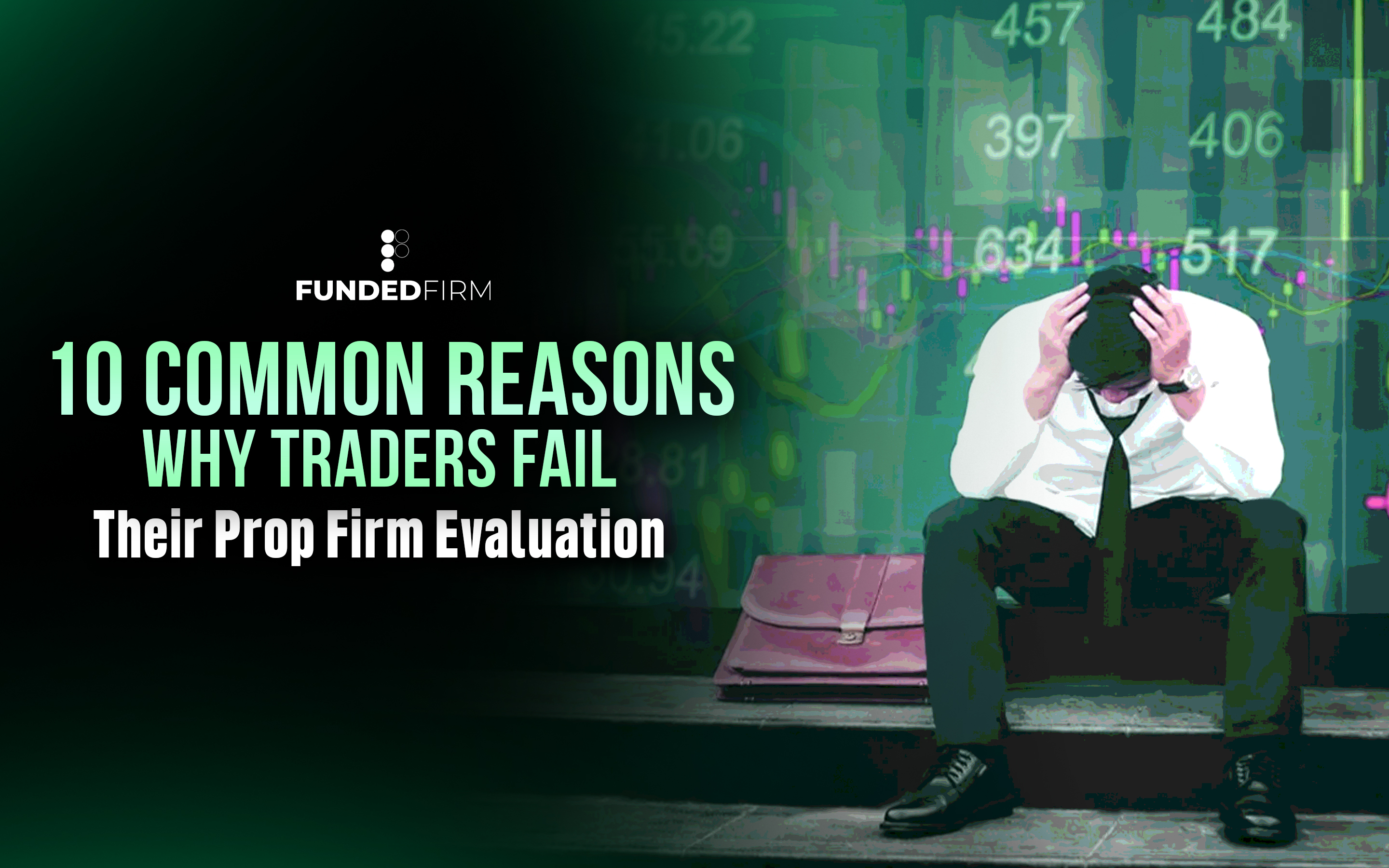
The path to becoming a funded trader at a proprietary trading firm is a dream for many seed traders. The chance to trade with millions, share the profits, and develop without putting one's own money at risk is very alluring. Unfortunately, the truth is quite the opposite; it is way harder to get through. Most traders find it impossible to live up to the demands of the evaluation phase. Statistics from the industry indicate that only 5-10% of traders manage to pass the prop firms' evaluation challenges and join the funded traders´ group, while 90-95% do not even reach that stage and thus fail. The main reasons for the failures are poor risk management, psychological pressure, and violations of the rules, but not a lack of trading knowledge.
1. Poor Risk Management Is the #1 Killer
Poor risk management is among the major causes of traders' failure in prop firm evaluation challenges. To safeguard their capital, prop firms enforce strict regulations on the daily losses and maximum drawdowns. A violation of these limits, even if the overall trading is profitable, will lead to immediate challenge failure. Traders who take excessive risks on individual trades or do not stop their losses at the estimated level very soon will be breaching these rules, thus making risk management discipline vital for any prop firm evaluation victory.
The statistics are sobering: over 50% of evaluation breaches occur due to violating daily drawdown rules. That alone paints a clear picture that risk discipline is the primary gatekeeper for success.
Every prop firm has its own specific evaluation rules, such as:
A greater than expected number of failures are caused not by poor strategies but by not comprehending or, even worse, by not applying these rules. For instance, if traders happen to be in profit, they may still lose their positions and money if they do not know the rules and hold a position when news that is not allowed to be released takes place.
In addition to this, many proprietary trading firms restrict trading to certain hours or set the minimum amount of trades each week to be made in order to keep the conditions for the traders’ consistency easy for them to slip unnoticed or violate under pressure.
Trading psychology plays a massive role, especially under evaluation pressure. Unlike regular demo or personal trading, prop challenges come with deadlines, fees, and the pressure to perform, which can trigger emotional decisions such as:
These behaviours lead to inconsistent results and ultimately account blows. According to external analysis, around 90% of traders lose money in retail environments, and psychological traits like fear and greed are key contributors.
Many traders attempt prop firm challenges without a well-defined trading plan. A proper plan should include:
You may also like to read : why most traders fail how avoid common mistakes
Entry and exit rules give a precise idea of the times to open and shut a trade. In the absence of precise rules, traders will operate under feelings or random signals, producing inconsistent results and incurring unnecessary losses.
Risk-to-reward ratios quantify the amount a trader is ready to risk for possible profit. If ratios are weak, traders can lose more than they win, which makes it hard for them to be profitable in the long run.
Position sizing determines the amount of capital that will be put at risk in each trade. In case of improper sizing, a couple of losing trades can lead to significant drawdowns, and therefore, push the company's risk limits thereby violating them.
Daily trading restrictions are one of the ways to avoid overtrading and impulsive decision-making. Excessive trading very frequently results in tiredness, errors, and greater risk-taking.
Certain situations, for instance, the announcement of substantial news and the existence of low liquidity, make the market more unpredictable. Hence, by staying away from such times, traders would not only be able to safeguard their funds but also perform equally well throughout the time.
In the absence of a plan, traders are likely to take impulsive actions based on short-lived price movements instead of moving probability. This inconsistency universally leads to a trader's constant failure.
Professional traders consistently use their trading plan as a guideline, a rulebook rather than a suggestion. The unsuccessful ones are those that often “feel” the market instead of trading by the established structure.
Overtrading is among the main errors in trading evaluation. A lot of traders are under the impression that it is necessary to trade on a daily basis or to meet profit targets in no time. Consequently, they enter poor quality setups just to be seen in the market.
Prop firms do not reward frequent trading; they reward consistency and discipline.
Overtrading incurs transaction costs, causes emotional fatigue, and leads to exposure to unnecessary risk. Traders who restrict their trades to high-probability setups are usually the ones reaping performance benefits over time.
Industry surveys indicate that traders who overtrade are 2–3 times more likely to violate drawdown rules.
Unrealistic expectations quietly kill accounts. A lot of traders think they will double their capital in a very short time or pass the challenge in a couple of days when taking part in prop firm trading contests.
Most challenges require 8–10% profit targets, which can realistically take weeks of disciplined trading. When traders rush the process, they often:
As per research conducted by Investing.com that looked into more than 25,000 trading accounts, it is found that the top 1% of traders are long-term thinkers, whereas the losing traders are after quick profits.
One of the usual mistakes made is getting into a challenge without proper preparation. Traders who have not completely verified their methods or exercised in realistic market situations usually do not get used to the real pressure even.
Preparation involves more than chart patterns. It requires:
High volatility, low liquidity, and news events bring about the distinct behaviours of markets. The traders whose strategies haven’t been tested over these conditions usually panic or choose poorly.
Psychological control is built through practice, and one of the reasons traders fail, emotional mistakes, is lowered by confidence, thus it is directly proportional to psychological control.
Leverage can multiply the gains; nevertheless, on the other hand, it can also multiply the losses much quicker. In the case of prop challenges, where the risk limits are strict and merciless, taking too much risk with positions is the end of the road.
Industry data suggests:
Traders who risk more than 2% of their capital per trade fail around 90% of the time.
This emphasises that stringent risk sizing is not just a good practice but a necessity. The traders with the largest funding that succeed the most often decide to under-risk on purpose, and they are sometimes risking only 0.5-1% of their capital per trade in order to shield themselves from the impact of the market fluctuations and the occasions of exceeding their maximum allowed loss.
Ignoring market conditions and technical factors is a common but underestimated reason traders fail prop firm evaluations. Even a solid strategy can break down if these elements are not properly managed. Below is a detailed explanation of each point:
Additionally, ignoring macroeconomic conditions, high-impact news, or unpredictable volatility can lead to unfavourable trade outcomes, especially when positions aren’t sized appropriately.
Following a defeat, certain traders get caught up in the trap of attempting to "win back" their money through bigger and riskier trades, a conduct referred to as revenge trading. This emotional reaction usually results in bad decisions, disregard for rules, and quick account losses. On the contrary, the successful traders consider the losses as useful data, not as a personal defeat. They accept that losses form an inherent part of the trading process and hence they keep their discipline, strictly adhere to their risk management rules, and concentrate on capital preservation to guarantee their long-term survival and consistency in the markets.
You may also like to read : How to Become a Successful Full Time Forex Trader
The sobering reality that we are faced with is: passing a prop firm evaluation is not so much about the perfect entry algorithm or secret strategy but rather about discipline, psychology, and rule compliance. This has been confirmed by external data on overall trading outcomes: even outside the prop firms, approximately 82% of retail traders lose money, usually because of bad risk-reward choices and trading influenced by emotions.
Therefore, if you are getting ready for your initial evaluation or repeating it after one or more losses, keep in mind that trading success is equally a psychological discipline and a technical one.
Controlling the risks, following the laws, and having the emotional discipline when under pressure will be the major factors in dramatically letting you in the 5-10% minority who get funded successfully.
Get funded today and start achieving your financial goals.

Be the first to know about promotions and discount
Ensure you manage your risk by never exceeding the set drawdown limits. Protect your capital and trade with discipline to preserve long-term profitability.
Achieve consistent profitability by adhering to your trading plan. Fundedfirms typically require a minimum monthly profit target to maintain funding and access to capital.
Follow the firm's guidelines regarding trading strategies, including asset types and trade volume. Staying compliant ensures you remain within the terms of the agreement and avoid penalties.



Trading involves risk and may not be suitable for all individuals. FundedFirm offers skill-based evaluations using simulated trading accounts only. Past performance does not guarantee future results. Funding and payouts are subject to program rules and compliance.
FundedFirm LTD. does not provide services for citizens/residents of the USA, Cuba, Iraq, Myanmar, North Korea, Sudan, Iran, Russia. The services of FundedFirm LTD. are not intended for distribution to, or use by, any person in any country or jurisdiction where such distribution or use would be contrary to local law or regulation.