


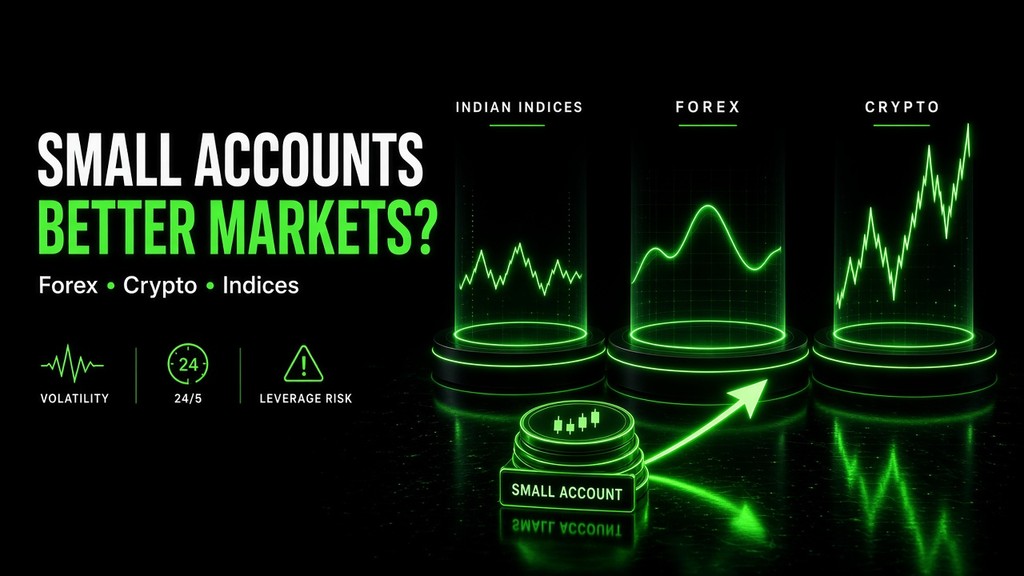
If you are investing for the long term, India’s growth story is hard to ignore.
If you are trying to grow a small account with intraday or short-term trading, the market you choose can matter as much as your strategy.
This guide is not “quit Nifty” or “everyone must trade crypto.” It is a clear comparison — the same way you compare phones before you buy one — so you can decide which arena fits a small account, a job, and a funded-trading path like FundedFirm.
Investing vs trading (do not mix them up)
For investing, many serious traders still keep their core wealth thesis on Indian equities and the country’s long-term trajectory.
For trading — especially intraday and short-term — you need different ingredients:
- Enough daily movement (volatility) to make risk–reward work
- Sensible capital efficiency (margin / leverage rules)
- Enough volume so setups actually play out
- A session that fits your life
- Costs that do not eat the account before skill shows up
Blind loyalty to “I live in India, so I only trade India” is not a plan. Priority is: which market lets a small account survive long enough to get good?
Point 1: Volatility — how far does price actually move?
Using multi-year average daily-type movement as a simple teaching lens (the exact % shifts by year, but the ranking stays useful):
| Market | Typical daily movement (illustrative) | What ₹100 “feels like” |
|---|---|---|
| Nifty | ~1% | Roughly ₹100 → ₹101 territory |
| Bank Nifty / similar indices | ~1.5–2% | More room than Nifty, still modest |
| BTC / major crypto | ~7–8% | Roughly ₹100 → ₹107–108 territory |
What this means for small accounts
- Low daily range + tight option premiums + brokerage = you need size or perfection to feel progress.
- Higher average range means a clean setup can produce a better reward relative to the same risk percentage — if you size correctly.
Bank Nifty is more volatile than Nifty; that is why experienced traders often prefer it for bigger P&L — and why beginners get hurt there. More movement demands more experience and tighter risk control.
Forex angle for FundedFirm traders: majors and crosses will not always move like crypto, but pairs like GBPJPY, XAUUSD, and news-driven majors regularly offer tradable ranges with deep liquidity. On a prop account you are paid for skill and rule adherence, not for owning the underlying asset.
Point 2: Leverage and capital efficiency
After leverage reforms in Indian derivatives, many retail traders felt the squeeze:
- Selling even one options lot can need large margin (often cited in the lakhs depending on product and broker).
- Index ranges stayed relatively small.
- Result: small capital + high margin + small daily move = growth feels impossible even when you are “not wrong” on direction.
Crypto platforms often advertise high leverage (e.g. 1:50, 1:100, 1:200). In plain English:
If you have ₹100 and 1:100 leverage, you can control about ₹10,000 of exposure.
That sounds like a gift. It is also how small accounts die in one candle. High leverage only helps if your stop, size, and setup quality are professional.
The FundedFirm alternative for small accounts
Instead of gambling 1:200 on a personal micro-deposit, many traders use an instant funded account or challenge path:
- You trade firm capital under clear rules
- You practice real size psychology without needing ₹5–10 lakh of your own margin
- Growth comes from payouts and scaling, not from blowing a ₹10k cash account on fees and over-leverage
That is often a cleaner “small account” solution than either undersized Indian options or reckless crypto leverage.
Point 3: Volume and “does the setup complete?”
In crypto (and in forex), participants come from the whole world. Liquidity is deep in the majors. When a trap, breakout, or liquidity grab forms, it more often finishes the story.
In thinner or more localized sessions, the same pattern can stall, wick, and reverse into your stop — especially when your size is already constrained by margin.
For structure traders (HH/HL, LH/LL, support/resistance): you want markets where pullbacks and breaks actually matter. Global FX and liquid crypto tend to reward that more than a quiet, low-range session on a tiny account.
Point 4: Session risk — gaps vs 24-hour markets
Indian cash/FO session roughly: open ~9:15, close ~3:30. Overnight:
- News can gap the open
- You may not manage stops the way you can in a continuously open book
- A gap against you can damage a small account before you click anything
Crypto trades 24/7 — no classic exchange gap in the same way.
Forex trades ~24/5 — weekend gaps exist, but intraday management is continuous during the week.
For risk control, continuous markets help you:
- Move stops
- Scale out
- Avoid “I was right but the open wiped me” stories
Point 5: Job, college, and when you can actually trade
If you work 9-to-5 or sit in college during Indian market hours, pure Indian intraday forces a hard choice: compromise the job or miss the session.
Many crypto volume hours run into the evening / night for India — after work.
Forex gives London and New York overlaps; many Indian traders run a evening London–NY playbook after office, same idea Harshita-style job traders use.
Small-account truth: the best market is partly the one you can trade alert and fresh, not half-asleep on a forced lunch break scalp.
Point 6: Holding flexibility (intraday jail vs swing room)
On some Indian intraday products, constraints and costs push you into “intraday only” behavior. Futures/options have their own expiry and margin rhythms.
In crypto perpetual/futures-style products (and in FX swings on a funded account), you can often:
- Map a higher-timeframe breakout
- Place invalidation
- Hold through a cleaner path to target — if rules and swap/fees allow
That does not mean hold forever with max leverage. It means your time stop is chosen by structure, not only by the bell.
Large account vs small account — different “better”
This is the part most comparison videos skip.
If capital is large (example thinking: high six/seven figures+)
- A steady few percent a month on Indian markets can be life-changing in absolute rupees
- You may not want crypto-sized volatility on that full stack
- Slow, liquid, regulated index/stock trading can be the rational choice
If capital is small (₹10k–₹1L class)
- Even a “safe” monthly win can vanish into brokerage and friction
- Margin gates lock you out of clean option structures
- Low daily range means you need either more risk % or more time — both painful
So: Indian markets can be better for big accounts; high-movement global markets (or funded forex) are often more practical for small accounts — with risk rules.
Where forex and FundedFirm fit in this comparison
The original conversation leaned crypto vs India. For FundedFirm readers, add the third column honestly:
| Factor | Indian indices (small a/c) | Crypto (small a/c) | Forex + funded account |
|---|---|---|---|
| Daily movement | Often low | Often high | Pair-dependent; gold/majors tradable |
| Capital efficiency | Tough after margin rules | High leverage available | Trade firm size under rules |
| Hours | Day session | 24/7 | ~24/5; great after-work overlaps |
| Gap risk | Overnight gaps | Continuous | Weekend gap risk only mostly |
| Main danger | Costs + tiny range | Blow-up from leverage | Rules breach / overtrading |
| Best for | Larger capital, investing core | Skilled volatility traders | Small accounts building process & payouts |
Many traders move to forex because they feel Indian intraday math does not work on small money. The mature version of that move is not “max lot on EURUSD” — it is structure + risk % + prop rules on an Instant or challenge account.
A sane experiment (not a revenge switch)
If Indian small-account trading has been a 1–3 year struggle with almost nothing left after costs:
- Do not dump a strategy that finally makes sense on India — keep a slice if it works.
- Ring-fence a test size (example mindset: ₹20k–25k of a ₹50k pile — numbers are illustrative).
- Trade one alternative lane for 4–8 weeks with a journal: liquid forex on a FundedFirm path, or carefully sized crypto — not both while emotional.
- Measure: net after costs, rule breaks, sleep, and whether setups complete.
- If it still fails, the market was not the only problem — process still needs work.
If India is already clicking for you, do not leave out of FOMO. Experiment when the current path is stuck — not when it is working.
Risk warning (read this twice)
- High leverage is not income; it is magnified error.
- Crypto and FX can move violently; small accounts vanish without hard daily loss caps.
- Funded accounts still fail when you chase, overtrade, or ignore drawdown rules.
- This is education, not financial advice. Follow your local laws and platform rules.
Key takeaways
- Investing ≠ trading. India can be excellent for investing and large-account trading; small-account intraday needs movement and efficiency.
- Volatility ranking (simple): majors crypto often >> Bank Nifty > Nifty for raw daily range.
- Margin + small range is why many sub-₹1L Indian F&O accounts feel stuck.
- 24h / 24/5 markets help job traders and reduce classic overnight gap pain.
- Large capital often prefers slower, deeper markets; small capital needs either better efficiency or funded size with discipline.
- For FundedFirm traders, the practical “small account upgrade” is often: learn structure on liquid FX → Instant/challenge capital → payouts, not gambling 1:200 on hope.
Pick the market that matches your account size, schedule, and risk maturity. Then master one playbook there. Switching markets every week is not diversification — it is restarting the learning clock with a thinner wallet.