


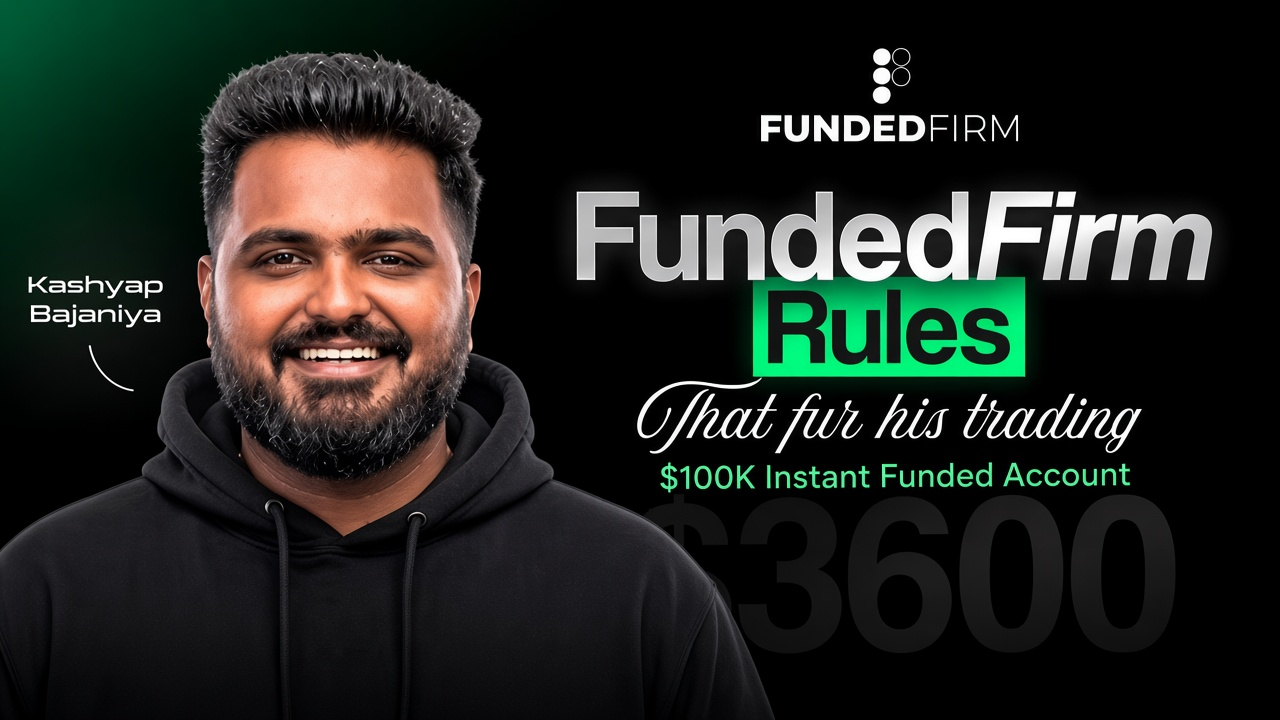
our years in the market. Nearly ₹15 lakh in losses. A civil engineer from Surat who almost quit—and did not.
Kashyap Bajaniya’s first FundedFirm result was not a long streak of withdrawals. It was one clean breakthrough: about $3,600 from a $100,000 instant funded account, cleared in roughly six trading days after he finally learned the rules the hard way.
This is his story from FundedFirm EP33—and another case for why an instant funded account only works when risk, discipline, and product fit show up together.
Who Is Kashyap Bajaniya?
Kashyap is from Surat, Gujarat. He completed a BTech in civil engineering but never took a corporate job. Trading became the path instead.
He has been in the markets for four years. The first two and a half were brutal. He thought about quitting. He never did. That refusal, he says, is why he is still here—and why he now runs a growing presence on Telegram and Instagram while trading full time from his own office setup.
His longer arc is simple to say and hard to live: lose, learn, stay, then earn.
How Trading Started: Greed at the Internship Site
Like many traders, Kashyap did not begin with a textbook. He began by watching someone else get paid.
During his civil internship, a senior engineer would arrive in the morning and, by mid-morning, show profits in the range of ₹25,000–₹30,000. Kashyap knew the stock market existed. He did not know how buy and sell actually worked. Seeing that money hit daily was the spark—and the greed.
He opened an Angel brokerage account and put in ₹50,000 from his own earnings without telling his family. The senior’s trades made money. Kashyap’s habits did not. He would trade even while going home to eat. Within 10 to 15 days, the ₹50,000 was gone.
His father later gave him ₹2 lakh. That did not become a clean zero in his telling, but it was not a success he could openly celebrate either. Pressure to take a job followed. He borrowed from friends. Over those years the debt stacked toward about ₹15 lakh.
He was close to walking away. He stayed. That decision is the spine of the interview.
From Indian Markets to Gold and Forex
Indian markets took the early damage. Then forex content started showing up in his feed. He moved into forex—and kept losing for a stretch—but still refused to quit.
He has traded gold and forex for about two years. Indian indices and stocks are no longer his active arena. He keeps SIPs running and barely opens those charts. He tried a comeback with ₹1 lakh, banked roughly ₹40,000–₹50,000, withdrew the profit, then watched an expiry day wipe the capital. His conclusion: that game was not his. Forex, for him, rewards price action and discipline more than the manipulation he felt in that later Indian attempt.
Why He Chose a FundedFirm Instant Funded Account
Kashyap had already tried another firm he names as Blue Guardian. The rules there, as he understood them, moved against the way he wanted to grow a buffer after profits, and the consistency logic felt punishing if an early trade was large.
What he liked about FundedFirm:
- Overall loss behaviour that did not feel like it “ate” his progress the same way after he made money
- A consistency approach where a smaller first print on the day could still let him build the day without the whole day being judged only like a max lottery ticket
- Rules clear enough that, once he understood them, he could plan around them
He bought FundedFirm almost as a try-out after Blue Guardian did not click. The product he chose was the Instant path—a $100,000 instant funded account.
That choice matters for the keyword and for the story: his first FundedFirm payout did not come from a two-step grind. It came from Instant.
The First Instant Funded Account: Breached in Minutes
Kashyap is honest about the first purchase.
He did not know the rules well enough. On the first instant funded account, he says the account was breached in two or three minutes. He took about $1,000 of loss in a single trade—size that, in his own words, is basically gambling. He was not averaging in that moment. He simply risked too much in one hit.
A friend and client walked him through how FundedFirm risk limits actually work—including that you cannot treat a single trade like a blank cheque. Within minutes of that conversation he bought another Instant account.
The second time, he traded with the rulebook in his head.
Six Days, Twelve Trades, First $3,600 Payout
On the second instant funded account, Kashyap says he finished the job in about six days. Every one of those days closed in profit. By the interview he was waiting on payout processing—roughly 15 days into that chapter.
Headline result: first FundedFirm payout of about $3,600.
Dashboard details he shared on camera:
- About 12 trades to clear
- Max / biggest loss around 2.63%
- Lot size kept in a fixed band—he mentioned working between roughly 1 and 50, and not increasing beyond his cap
- Strategy built on 10 EMA and 20 EMA, with a clear candle condition, a stop buffer (he described about 10 pips beyond the level), and a 1:2 risk-to-reward plan
- Setups that are rare but high accuracy—he would rather wait than force
He also owns a mistake on payout selection: he picked the on-demand split option without understanding it fully, instead of the higher 80% weekly-style path. He expects roughly $2,000 of that payout to land for him under on-demand terms, and he plans to put that money back into his trading capital / investment stack. The lesson sits next to the win: product knowledge is part of risk management.
Live Account vs Instant Funded Account
Kashyap still trades live capital alongside prop. His contrast is practical:
| Live account | Instant funded account |
|---|---|
| Emotions stay | Emotions stay—but the cost of a mistake is clearer |
| You can often deposit again after a blow-up | One serious rule break can end the account |
| Broker margin can zero you in seconds if size is reckless | Rules force smaller, planned risk |
| Easy to trade without a checklist | Discipline and psychology get trained under limits |
His point: an instant funded account is not “fake pressure.” It is structured pressure. If you are already profitable in small size, that structure can pay. If you are still gambling, Instant will expose it fast—as his first two-minute breach showed.
Psychology: The Weakness He Still Watches
Even now, after a stop-out, his mind can argue: why did the market take my stop? Fresher Kashyap moved stops and added size almost daily. Current Kashyap still feels that urge maybe once in 15 days—but he knows how much risk he can take, and he can sit with a loss he could not face before.
His rules for ugly days:
- After two or three stop-losses in a row, he closes the day
- He does not keep the account open to “make it back”
- He writes what went wrong so he does not repeat it
- Next session: only his setup—even if that means one trade, or none
He tells his Telegram community the same thing. Revenge trading after two or three hits is how accounts die. He would rather protect capital for tomorrow than force today’s ego.
Routine: 4:30 AM Trader
Kashyap trades full time from an office he equipped for it.
- Wake around 4:30 AM
- Gym by 5:00—and he admits the charts still get attention there
- Home, then office by about 8:30–9:00
- Evening home again around 8:30–9:00
Morning trades are where he feels highest accuracy. He shares ideas with a Telegram audience he puts around 30,000 members—while still treating his own risk rules as non-negotiable.
Away from the desk, FOMO is real. The phone stays close. Family may ask him to put it down at meals. He still checks. What he will not do is enter without a setup. He says he can sit 12–13 hours watching for the EMA condition and still take nothing if it never prints. Capital left for tomorrow beats a forced entry today.
Advice for Beginners (and Anyone Buying Instant)
Kashyap’s advice stacks into a short list:
- Trust the setup. Stop-loss and target on—then leave it alone.
- Do not average a loser hoping to exit in profit. It may work a few times. When it fails, it can zero the account.
- Stop after consecutive losses. Two or three stops is enough for the day.
- Fix risk per trade before you click. Fresh traders who load huge size on tiny capital can erase an account in 50 pips.
- Discipline + risk together. One without the other is not enough.
That is also how an instant funded account stays alive. Instant removes evaluation phases. It does not remove the need for a stop, a size cap, or the humility to shut the platform after a bad streak.
Quick Facts From EP33
| Detail | What Kashyap shared |
|---|---|
| Name | Kashyap Bajaniya |
| Location | Surat, Gujarat |
| Background | BTech civil engineer; full-time trader |
| Experience | ~4 years; ~2 years gold/forex focus |
| Early capital damage | ~₹15 lakh path of losses/debt |
| FundedFirm product | $100K instant funded account |
| First Instant attempt | Breached in ~2–3 minutes (oversized single loss) |
| Second Instant | Cleared in ~6 days; ~12 trades |
| First payout | ~$3,600 |
| Max loss shown | ~2.63% |
| Method | 10 EMA + 20 EMA, buffer stop, ~1:2 RR |
| Community | Telegram ~30,000 members |
| Key habits | Stop after 2–3 losses; no trade without setup |
Final Thoughts
Kashyap’s first FundedFirm payday was not luck dressed as a story. It was a trader who burned years and rupees learning what not to do, breached an instant funded account in minutes by ignoring risk, then bought a second Instant with the rules finally clear—and cleared it in six disciplined days.
$3,600 later, he is still the same engineer who refused to quit after ₹15 lakh of hard lessons. The difference is process: EMA setups he trusts, a hard stop on revenge days, and an instant funded account that pays only when that process survives the rulebook.
If you are comparing Instant options because challenges keep ending in the same emotional leak, watch the full conversation: His First $3,600 First Payout with Fundedfirm | Kashyap Bajaniya | EP33. Then read FundedFirm’s current Instant terms before you buy—knowing the payout split and the loss limits is part of the trade.
Based on Kashyap Bajaniya’s FundedFirm interview (EP33, October 2026). Individual results vary. FundedFirm offers skill-based evaluations using simulated trading accounts. Trading involves risk. Past performance does not guarantee future results. Always follow the rules of your specific program, including Instant account terms.