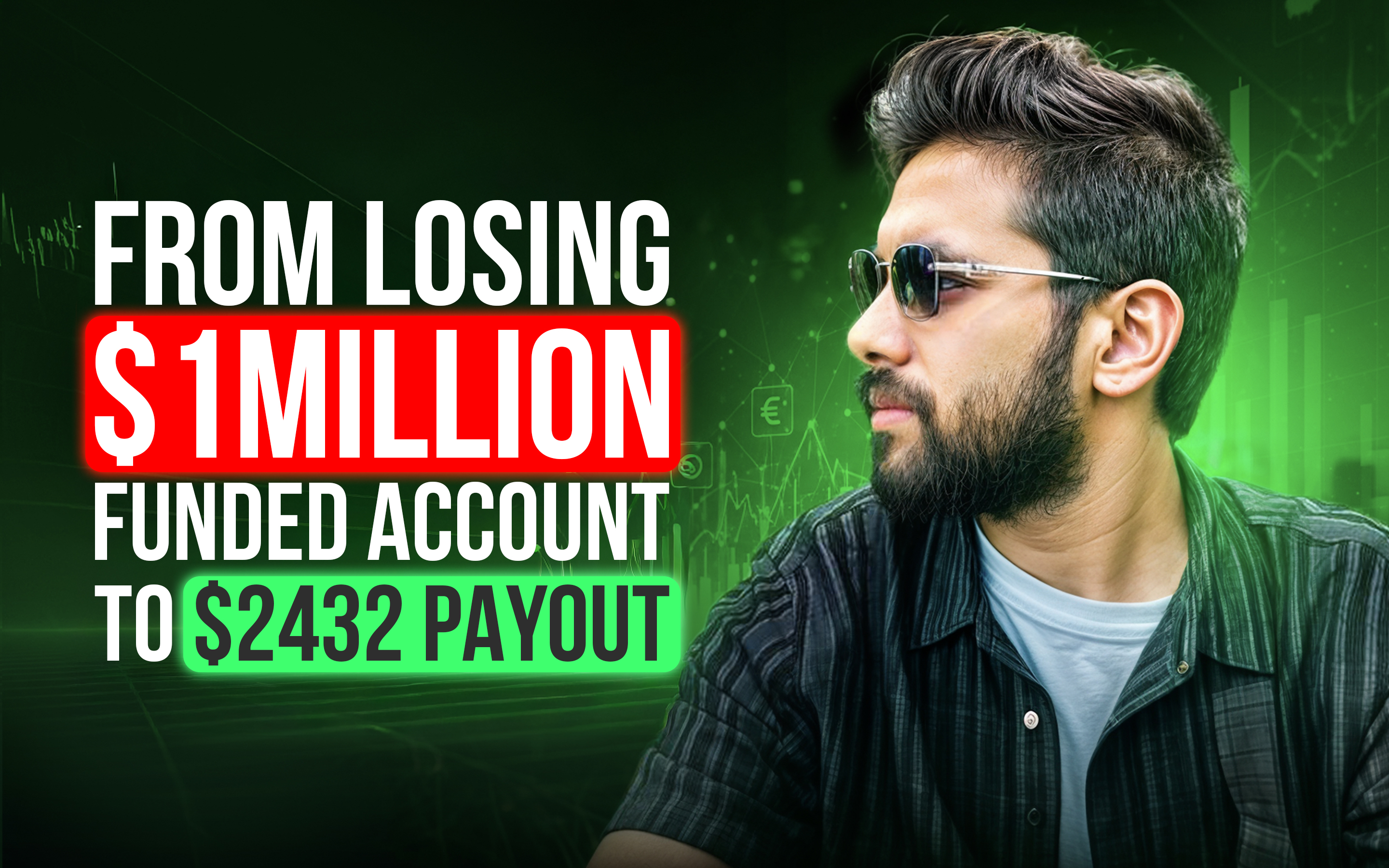
Sagar Anand’s journey from an IIT BHU graduate to a profitable funded trader is nothing short of inspiring. While most IIT graduates walk into high-paying corporate jobs, Sagar walks into the uncertain world of trading.
He began trading in his second year of college, driven by curiosity and the desire to build something of his own. What started as an experiment soon became a full-time commitment though the path was anything but easy.
For nearly two to three years, he traded in losses. He tried multiple funded firms, starting with My Forex Funds, managing accounts worth $1 million before the firm was banned, wiping out all his progress overnight.
Still, he didn’t quit. He went on to try Engineer Funded and Funded Next, but payouts remained elusive. Every attempt ended with rejection, each citing new reasons. Then came a turning point discovering the FundedFirm.
Even after several blocked accounts, Sagar’s persistence paid off when he finally received his first payout, marking the beginning of his comeback story.
Before becoming a trader, Sagar had already decided that he didn’t want a traditional job. During college, he tried entrepreneurship, launching a café business but it didn’t succeed.
When a friend introduced him to trading, he jumped in without any prior experience or market knowledge. Starting directly in foreign markets, he suffered heavy losses but gained invaluable lessons about psychology, discipline, and market behavior.
Over time, he built structure, learned risk management, and found his rhythm in trading.
When asked why he chose to work with FundedFirm , Sagar highlighted two key features that matched his trading style perfectly.
First, the firm did not enforce lot-size consistency, allowing flexibility. For instance, if he didn’t want to trade aggressively a week before payout, he could reduce his lot size freely.
Second, the 30% profit booking rule often seen as restrictive actually helped him. According to Sagar, the rule encourages traders to book profits systematically instead of chasing unrealistic returns. It adds discipline and helps manage expectations.
His persistence finally paid off when he passed Phase One in 65 days and Phase Two in just two days.
During Phase One, he was trading both his funded and personal accounts simultaneously. His funded account once dropped to a 9.4% drawdown, leaving only 6% equity. But instead of giving up, he treated the remaining $300 as if it were his personal capital.
He set a small target to turn $300 into $500. After achieving it, he took a 1:3 risk-reward trade and gradually brought his account back, eventually completing the challenge and earning validation from the company without any objections.
Sagar’s trading journey was filled with challenges, emotional decisions, overtrading, and psychological fatigue.
According to him, the biggest mistake traders make is not accepting losses. A 1% loss often turns into a 3% loss simply because traders refuse to stop. He admitted that he faced the same problem early on.
To counter it, he created personal rules: if he lost 1% or even 0.5%, he would stop trading for that session. These boundaries helped him control emotions and stay objective.
He also learned the hard way that mobile trading can be dangerous. Once, he lost $1,682 (3%) because he executed trades on his phone instead of using a proper setup. Since then, he strictly trades only on his PC.
Sagar credits his turnaround to the flexibility and structure provided by his funded firm.
The lack of lot-size restrictions allowed him to trade based on conditions rather than rigid rules. The 30% profit rule reinforced discipline, preventing impulsive trading and improving long-term consistency.
The firm also provided a transparent environment with no hidden limitations or delays, giving him confidence to focus solely on execution.
His performance record shows steady progress after receiving his funded account on September 11, he gained 5%, then 1%, faced minor losses, and later experienced a large one-day loss of $1,682.
After taking a short break in October, he came back stronger, posting consistent gains of 2.5% and 1.5%, and eventually withdrew 5% profit from his account.
Sagar specializes in Gold (XAU/USD) and focuses mainly on the New York and Asian sessions, while avoiding the London session.
He identifies himself as a volume-based trader, someone who reads the market through the flow of buying and selling activity.
His golden rule:
“If heavy buying volume appears in the New York session and price doesn’t move more than 100 pips, expect a strong 250–300 pip move in the Asian session.”
He monitors volume from 5:00 PM Indian Time, just before the New York session opens at 5:30 PM. When a high-volume candle forms, he waits for the next candle to break its high. This setup often delivers 1:2 or better scalping opportunities, with about a 70% success rate.
Around 6:30 PM, when high volume starts to peak and then decline around 6:45 PM, he looks for breakout trades. He places a stop loss below the high-volume candle and enters when the high breaks, often achieving 1:3 or 1:4 risk-to-reward ratios.
Sagar prefers buying opportunities, especially in the current bullish gold market, but acknowledges that similar setups can also work on the short side when lows break.
Sagar’s trading records demonstrate how discipline can transform performance:
His dashboard shows dozens of trades with small lot sizes (0.1 lots), spaced by three minutes to maintain accuracy in execution tracking. Most of these trades earned 1–1.5% each, following the same volume breakout structure.
Even during a 9% drawdown, Sagar remained mentally composed. He reminded himself that losing is part of the game and that the key is how a trader reacts after a setback. His recovery from -9% to +8% profit demonstrates both his strategy and his mindset.
Sagar believes that trading is 80% psychology and 20% execution. He often repeats his favorite mantra:
“Loss will happen, but how you work during the loss is what’s important.”
He explains that traders who let emotions control them after a loss often sabotage their next trades. Instead, he maintains calm and focuses on the long-term outcome.
His approach to drawdowns is simple: accept them, analyze them, and move on. His story proves that composure and discipline can turn even the deepest drawdown into a comeback.
From an unprofitable beginner to a funded trader receiving regular payouts, Sagar’s transformation highlights the power of persistence.
His success is not a result of luck or shortcuts but of continuous self-improvement. He worked through years of setbacks, learned from every failure, and built strategies rooted in data and discipline.
Sagar’s journey stands as a reminder that every trader starts with mistakes, but consistency, patience, and structure lead to growth.
His philosophy can be summarized simply:
“Losses are part of the game. What matters is how you bounce back.”
From the classrooms of IIT BHU to the trading screens of global markets, Sagar Anand has proven that resilience can transform even the toughest beginnings into remarkable success stories.
His path continues to inspire new traders striving for financial independence, showing that with discipline, patience, and the right mindset, true progress is always within reach.
Get funded today and start achieving your financial goals.

Be the first to know about discounts
Ensure you manage your risk by never exceeding the set drawdown limits. Protect your capital and trade with discipline to preserve long-term profitability.
Achieve consistent profitability by adhering to your trading plan. Fundedfirms typically require a minimum monthly profit target to maintain funding and access to capital.
Follow the firm's guidelines regarding trading strategies, including asset types and trade volume. Staying compliant ensures you remain within the terms of the agreement and avoid penalties.



Trading involves risk and may not be suitable for all individuals. FundedFirm offers skill-based evaluations using simulated trading accounts only. Past performance does not guarantee future results. Funding and payouts are subject to program rules and compliance.
FundedFirm LTD. does not provide services for citizens/residents of the USA, Cuba, Iraq, Myanmar, North Korea, Sudan, Iran, Russia. The services of FundedFirm LTD. are not intended for distribution to, or use by, any person in any country or jurisdiction where such distribution or use would be contrary to local law or regulation.