If you have spent even a little time watching the forex market, you have probably noticed something. Prices do not always move smoothly. Some days feel calm, almost predictable. Other days feel chaotic, like the market has a mind of its own.
A big reason behind those sudden moves is central bank policy.
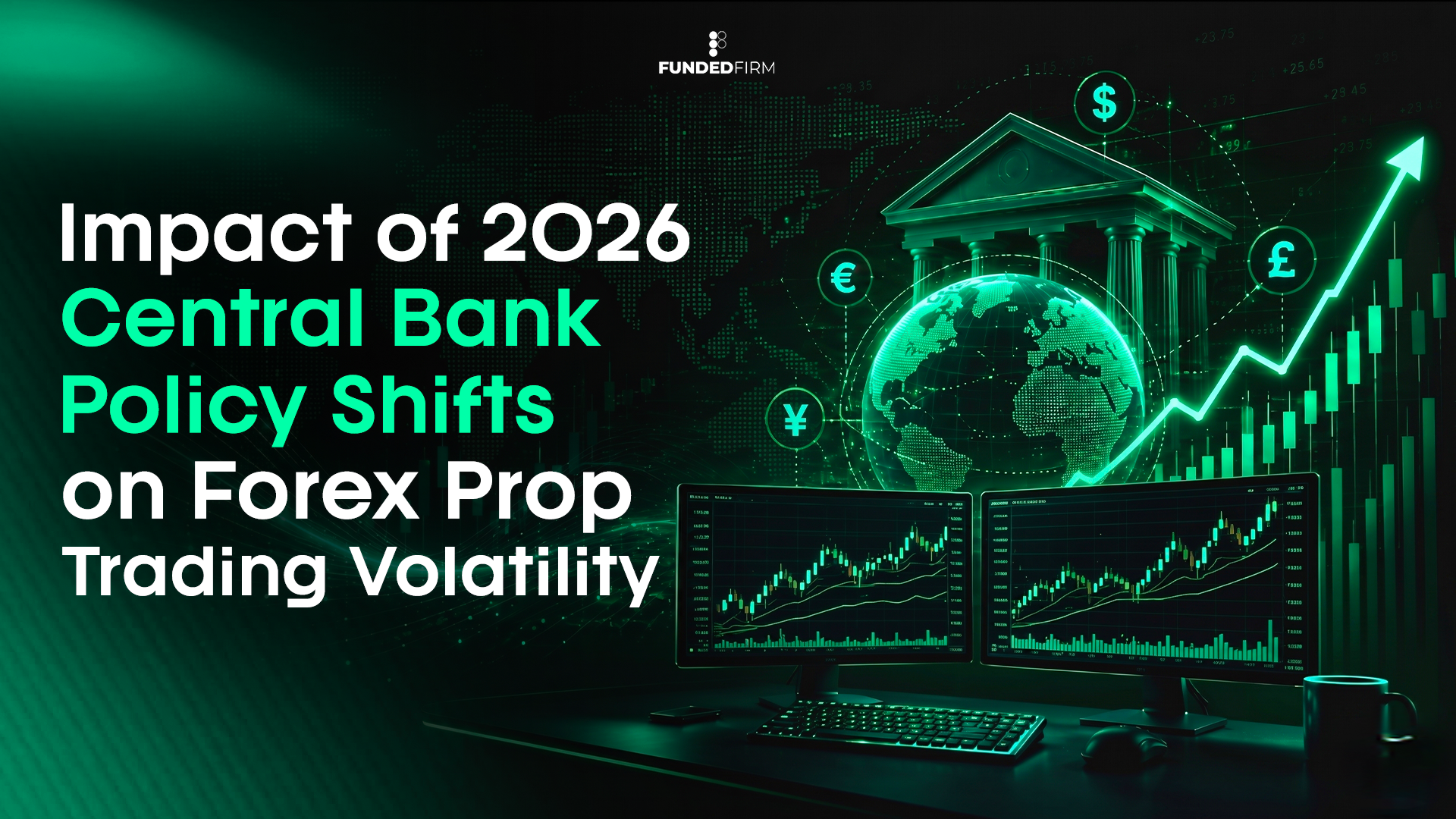
In 2026, traders are paying even closer attention to interest rate decisions, policy guidance, and global economic signals. For prop traders especially, these shifts are not just background noise. They directly shape volatility, risk, and opportunity.
Many beginners wonder if trading during such events is safe, or even allowed in prop firms. The answer is simple. Yes, it is allowed. But it comes with conditions. Some firms restrict trading during high impact news. Others allow it but expect strict risk management.
So the real question is not whether you can trade these events. It is whether you should, and how to approach them smartly.
Let’s break it down in a way that actually makes sense.
Think of the forex market like a busy highway.
On normal days, traffic flows at a steady pace. You can predict movement, switch lanes calmly, and reach your destination without stress.
Now imagine a sudden storm hitting the highway. Visibility drops. Cars slow down or speed up unpredictably. Some drivers panic. Others try to take advantage of open lanes.
Central bank announcements are that storm.
When interest rate decisions or policy updates are released, the market reacts quickly. Liquidity changes. Volatility spikes. Price movements become sharper and less predictable.
For prop traders, this is where things get interesting. And risky.
Before diving deeper, it helps to understand how traders approach these events.
You join a prop firm
You get access to a funded account
You follow their rules about news trading
You track macroeconomic events forex calendars
You plan trades around key announcements
Most traders eventually come across events like FOMC trading sessions or central bank rate decisions. At first, it feels intimidating. You might even avoid trading during these times.
That is completely normal.
Over time, you start recognizing patterns. Not perfect patterns, but tendencies.
Not every year behaves the same way.
2026 is shaping up to be a year where central banks are adjusting policies after years of economic shifts. Inflation control, economic growth concerns, and geopolitical factors are all influencing decisions.
This creates uncertainty.
And uncertainty leads to volatility.
Interest rates do not stay static forever. Central banks raise or cut rates depending on economic conditions.
In 2026, many major economies are either:
Rebalancing after aggressive rate hikes
Considering gradual rate cuts
Or holding rates steady while watching inflation
Each of these scenarios affects currency strength.
Even small changes in expectations can move the market.
Markets are reacting faster than before.
A single inflation report or employment number can shift expectations about future interest rate decisions.
This means traders are not just reacting to central bank announcements. They are reacting to everything leading up to them.
This is where things become practical.
Central bank actions influence currency values in a direct way.
When a central bank raises interest rates, its currency often becomes stronger.
Why?
Because higher rates attract investors looking for better returns.
When rates are cut, the opposite tends to happen.
But here is where it gets tricky.
The market often moves based on expectations, not just the decision itself.
If traders expect a rate hike and it happens, the move may already be priced in.
If the decision surprises the market, volatility increases sharply.
Central banks do not just announce rates. They also provide guidance about the future.
This guidance can sometimes move the market more than the actual rate decision.
A slightly cautious tone can weaken a currency. A confident outlook can strengthen it.
For prop traders, reading between the lines becomes an important skill.
FOMC trading refers to trading around decisions made by the Federal Open Market Committee.
These events are among the most watched in the forex world.
During FOMC announcements:
Spreads often widen
Price moves become fast and sharp
Liquidity can fluctuate
Some traders avoid these sessions completely.
Others focus only on them.
There is no single correct approach.
It depends on your strategy and risk tolerance.
High impact news events are not limited to central banks.
They include:
Inflation reports
GDP data
Employment numbers
Geopolitical developments
But central bank announcements often combine all these factors.
Price can spike in both directions within seconds.
Stop losses may not execute at expected levels.
Emotional decision making increases.
Even experienced traders sometimes get caught off guard.
Strong trends can form quickly.
Breakouts become more reliable after initial volatility settles.
Momentum traders can benefit from sharp moves.
The key is timing and discipline.
There is no one size fits all strategy. Still, a few common approaches stand out.
This might sound boring, but it is effective.
Many successful prop traders simply avoid trading during high impact news.
They wait for the market to settle.
Sometimes, doing nothing is the smartest move.
Some traders wait for the initial spike and then trade breakouts.
The idea is simple.
Let the market show direction first.
Then enter with confirmation.
This reduces the chances of getting caught in fake moves.
This is more advanced.
Traders take positions before the announcement based on expectations.
It can be profitable, but also risky.
If the market reacts differently than expected, losses can be quick.
Even experienced traders slip up during volatile periods.
One mistake is overtrading.
When the market moves fast, it feels like there are endless opportunities. In reality, this often leads to poor decisions.
Another mistake is ignoring prop firm rules.
Some firms restrict trading during high impact news. Breaking these rules can lead to account loss.
Then there is emotional trading.
Fear and greed become stronger during volatility. This can push traders into impulsive decisions.
Risk management becomes even more important during central bank events.
Smaller trades help control risk when the market is unpredictable.
Tight stops may get triggered too easily.
Wider stops can help, but only if position size is adjusted accordingly.
Not every move can be predicted.
Accepting this reduces emotional pressure.
This part is often ignored, but it matters a lot.
Volatility can feel exciting. It can also feel stressful.
You might see large moves and feel like you are missing out.
That feeling leads to rushed trades.
Experienced traders learn to stay calm.
They understand that opportunities are always there. Missing one trade does not matter in the long run.
Central bank policy shifts are not something you can ignore in forex trading. In 2026, they are shaping the market more than ever.
For prop traders, this creates both challenges and opportunities.
You do not need to trade every high impact news event. In fact, you probably should not.
Focus on understanding how the market reacts. Build patience. Respect volatility instead of chasing it.
Over time, you will start seeing patterns. Not perfect ones, but enough to guide your decisions.
Trading is not about catching every move. It is about staying consistent, protecting your capital, and improving gradually.
Stay disciplined. Follow your prop firm’s rules. And remember, steady progress always beats reckless speed in the long run.
Get funded today and start achieving your financial goals.

Be the first to know about promotions and discount
Ensure you manage your risk by never exceeding the set drawdown limits. Protect your capital and trade with discipline to preserve long-term profitability.
Achieve consistent profitability by adhering to your trading plan. Fundedfirms typically require a minimum monthly profit target to maintain funding and access to capital.
Follow the firm's guidelines regarding trading strategies, including asset types and trade volume. Staying compliant ensures you remain within the terms of the agreement and avoid penalties.



Trading involves risk and may not be suitable for all individuals. FundedFirm offers skill-based evaluations using simulated trading accounts only. Past performance does not guarantee future results. Funding and payouts are subject to program rules and compliance.
FundedFirm LTD. does not provide services for citizens/residents of the USA, Cuba, Iraq, Myanmar, North Korea, Sudan, Iran, Russia. The services of FundedFirm LTD. are not intended for distribution to, or use by, any person in any country or jurisdiction where such distribution or use would be contrary to local law or regulation.