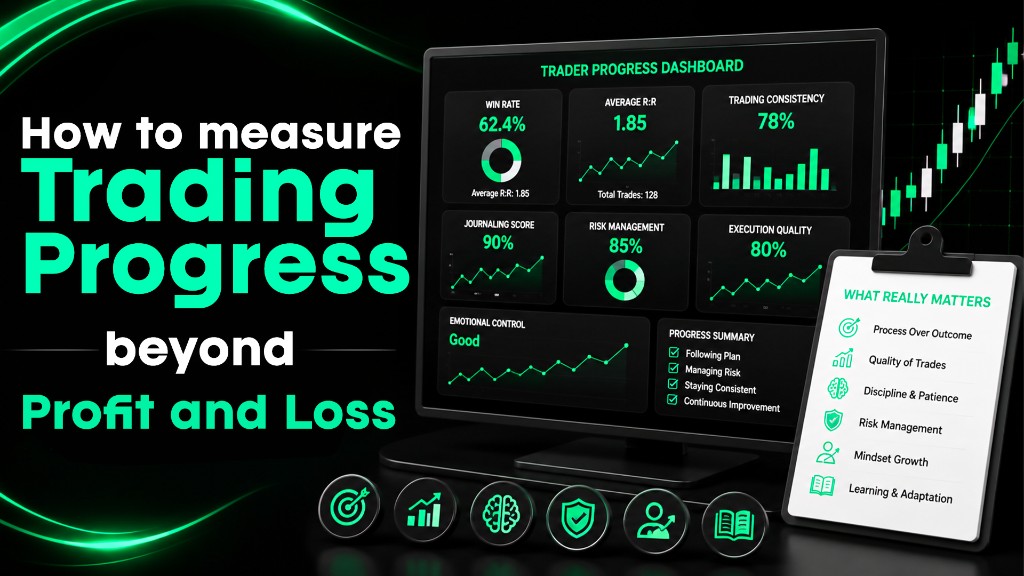
Profit and loss (P&L) is commonly used as an indicator of trading success. Even though making profits consistently is significant, it is not necessarily an indicator of how good a trader you have become. Many traders are able to make money due to favorable market circumstances and not necessarily because they have developed their skills. Similarly, the fact of losing money does not necessarily indicate inefficiency of a strategy.
The best way to measure trading progress is through the evaluation of the behaviors and practices leading to success. This allows traders to analyze their skills and work on weaknesses and strengths to create a consistent approach to trading.
We will be talking about the methods of measuring your progress in trading via the trading performance metrics and a trading journal.
All traders have periods of profit and loss. Sometimes the short-term profits are simply due to luck, but losses can even happen despite having a good strategy in place.
When you concentrate solely on your account balance, you risk neglecting some essential factors, such as:
When you measure trading progress based on other indicators as well, you will get a better grasp of your trading progress.
Rather than focusing only on profits on a daily and weekly basis, pay attention to some other important metrics that will tell you how well your strategy is working. For a full weekly scorecard, see The Hidden Metrics Every Profitable Trader Tracks Weekly.
Some useful metrics are:
Your winning percentage reflects the number of winning trades out of all your trades. Nonetheless, having a good winning percentage does not necessarily mean you will be making money if your losses far outweigh your profits.
It reflects the relationship between what you stand to lose versus what you stand to gain from your trades. Even traders who have an average winning percentage can be profitable by having a good risk-reward ratio.
Calculating the average gains and losses helps identify whether your trading strategy is generating profits.
Drawdown is measured as the biggest fall in value in your trading account over a specified period. Drawdown values tend to be an indicator of good discipline.
Checking trading performance metrics regularly gives you more information than just checking your profit and loss account.
A good trading journal will be one of the best ways to monitor your trading journey. This needs to include information like entry price, exit price, trade setup, position size, risk percentage, market conditions, mood during that trade, and what was learned through that trade.
Going through this information on a regular basis will help to spot common errors, successes, and behavioral patterns. A good trading journal will enhance decision-making and develop discipline.
Skilled traders realize that preserving their money is just as crucial as making profits. Good risk management in trading can help minimize large losses and keep you in the game for a long time to come.
Questions you should be asking yourself are:
Enhancing your risk management skills will bring about steady results, although your profits may not go up immediately. Consistency, preservation of capital, and adherence to prearranged limits all point toward future success in trading.
Markets always put a trader's psychology to the test. Fear, greed, impatience, and overconfidence can all impact your decisions.
Good trading psychology is the best measure of long-term progress. Related: How to Make Your Emotions Numb in Trading and Why Decision Fatigue Is Costing Traders More Than Bad Strategies.
Assess your own performance by asking yourself:
Enhancing your state of mind avoids the pitfalls of emotional errors and ensures consistency despite any prevailing circumstances.
In addition to the profit numbers, try to set realistic and achievable goals based on process rather than financial gain. Sticking to your trading strategy, keeping up with your trading journal, managing your risks in each transaction, performing a weekly review of your progress, and not acting on impulses are all part of creating successful practices.
Such disciplined behavior will ensure continuous improvement and consistency, which is essential for measuring trading progress. Probability thinking also supports process over single-trade outcomes — read The Role of Probability Thinking in Consistent Trading Success.
Progress should be measured over weeks or months rather than every single trading day.
You should prepare for your weekly or monthly review to include:
Weekly/monthly reviews help integrate the information from your trading performance metrics and the insights from your trading journal. Consistently reviewing the information will allow you to detect trends, make good decisions, and adjust your trading approach accordingly.
The financial markets continue changing; therefore, there is a need to learn constantly to be able to trade successfully. You can develop your trading skills by reading books about trading, analyzing how the markets behave, testing trading systems, evaluating previous trades, and learning from experienced traders. Increasing your knowledge base will help you cope with the changes in the market environment.
Learning to track and measure trading progress is much more than keeping tabs on your daily gains and losses. The true measure of your progress depends on the formation of good habits, improved decision-making, emotion control, and efficient risk management. In order to see how far you have progressed in your trading, you should keep an eye on your trading performance metrics, trading journal, risk management in trading, and trading psychology.
Do not forget that successful trading does not depend on the number of winning trades but on the progress in your own consistency and discipline as a trader.
Ready to build consistency with clear rules and capital? Get funded with FundedFirm — and review the official trading rules before your next evaluation.
Get funded today and start achieving your financial goals.

Be the first to know about promotions and discount
Ensure you manage your risk by never exceeding the set drawdown limits. Protect your capital and trade with discipline to preserve long-term profitability.
Achieve consistent profitability by adhering to your trading plan. Fundedfirms typically require a minimum monthly profit target to maintain funding and access to capital.
Follow the firm's guidelines regarding trading strategies, including asset types and trade volume. Staying compliant ensures you remain within the terms of the agreement and avoid penalties.



Trading involves risk and may not be suitable for all individuals. FundedFirm offers skill-based evaluations using simulated trading accounts only. Past performance does not guarantee future results. Funding and payouts are subject to program rules and compliance.
FundedFirm LTD. does not provide services for citizens/residents of the USA, Cuba, Iraq, Myanmar, North Korea, Sudan, Iran, Russia. The services of FundedFirm LTD. are not intended for distribution to, or use by, any person in any country or jurisdiction where such distribution or use would be contrary to local law or regulation.