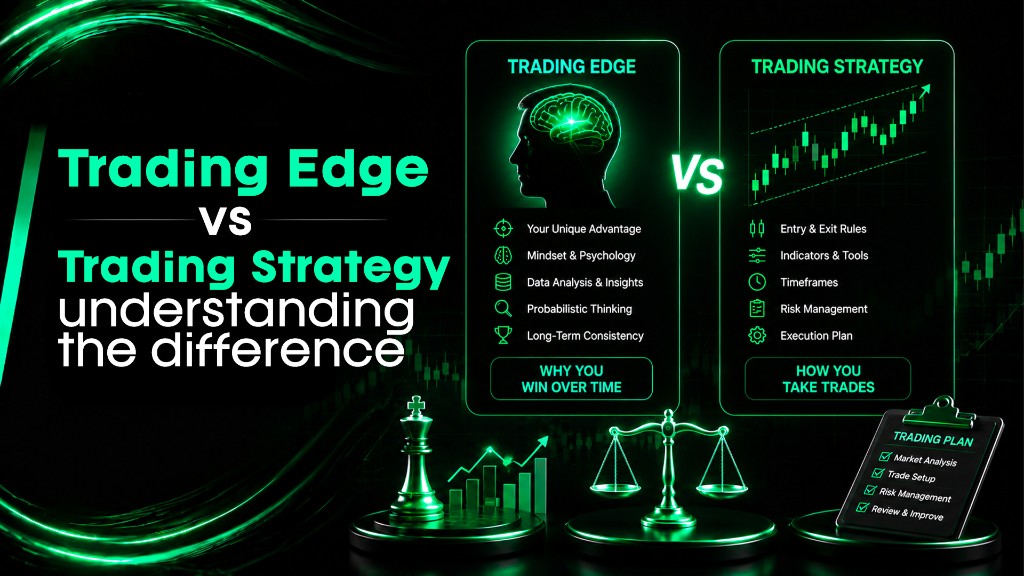
Many novice traders think that having an effective trading strategy alone would be enough to succeed in the financial markets. But the truth of the matter is that experienced traders realize the importance of having more than just a set of strategies that can ensure profitability in the market. A trading strategy will tell you when to get into and out of the trade while a trading edge will give you the probability of making profits from the trades you make.
There is much difference between a trading edge and a trading strategy.
A trading strategy is a structured plan that defines how a trader enters, manages, and exits trades. It provides clear rules that reduce emotional decision-making and improve consistency.
A strategy typically includes:
For example, a trader may buy when a 50-day moving average crosses above a 200-day moving average and exit once a predetermined profit target is reached.
A strategy serves as a roadmap, but following one does not automatically guarantee profitability.
An edge in trading refers to the statistical advantage, which makes it possible for a trader to make profit consistently over many transactions. This edge defines what makes a trading strategy work better compared to making decisions randomly.
The sources of an edge in trading include:
In other words, an edge improves the chances that your transactions will be successful.
An edge in trading is necessary because without it any trading strategy may not work in changing market conditions. Probability thinking is a core part of building that edge — see The Role of Probability Thinking in Consistent Trading Success.
Understanding these essential trading keywords helps traders build stronger knowledge, improve decisions, manage risks, and achieve consistent market performance.
Risk management is an essential component of any trading strategy because limiting losses is much more important than maximizing gains since preservation of funds ensures that a trader is able to stay in the game. Successful traders usually risk a very small amount of the whole trading account on each transaction.
Technical analysis is used by most traders for identifying market trends, support and resistance levels, potential trading points and developing trading strategy based on the market behavior.
Price action trading technique is widely used by professional traders due to the fact that it is based on the actual behavior of the market instead of indicators.
Even the best strategy cannot bring any results without good trading psychology since such negative emotions as fear, greed, impatience, and overconfidence make a trader forget about his rules. Emotional discipline enables traders to follow the rules even when the result of a transaction is bad. Related: How to Make Your Emotions Numb in Trading.
Backtesting trading strategy techniques are used by most professionals to test their strategy on the historical market data before using them in real practice.
| Trading Strategy | Trading Edge |
|---|---|
| Defines trading rules | Provides statistical advantage |
| Focuses on execution | Focuses on profitability |
| Can be copied by anyone | Often developed through experience |
| Includes entry and exit rules | Includes decision-making quality |
| May stop working in changing markets | Evolves with market conditions |
| Easy to learn | Takes time to develop |
Though different from each other, they are complementary to each other. One trader may have a good strategy but lose because of lack of discipline, whereas another trader may have a simple strategy but do well owing to good implementation.
Indeed, that's correct.
Beginner traders usually buy pre-made strategies from websites. Though such systems provide trading instructions, they might not have an advantage, since markets are ever-changing.
The reasons for losing the system's efficiency can be:
That's why imitation of others' systems almost never works out.
It is not quite as frequent.
Some traders, through many years of trading, acquire a certain intuition about how markets behave. It just comes automatically.
Yet, in most cases, even those traders have their processes going on in the background.
The edge loses its value when there is no execution, because eventually emotions will play a role in decision-making. Decision fatigue also erodes execution quality — read Why Decision Fatigue Is Costing Traders More Than Bad Strategies.
Developing an edge takes time, patience, and continuous learning.
Consider these practical steps:
Learn how different markets respond to news, economic events, and changing volatility.
Record every trade, including:
Reviewing past trades helps identify recurring strengths and weaknesses. Track progress beyond P&L with How to Measure Trading Progress Beyond Profit and Loss.
Many professional traders become profitable not because they win more often but because they control losses more effectively.
Experiment with different methods across various market conditions. Some strategies perform well during trends, while others work better in ranging markets.
Financial markets evolve continuously. Successful traders regularly refine their knowledge and adapt to new market environments.
The problems faced by many traders arise because of their lack of understanding about the connection between trading strategies and edges.
These problems are the most frequent ones:
Also see: Why most traders fail and how to avoid common mistakes.
Trading strategy is akin to the design of a house.
A trading edge is the material quality and experience which would allow the house to stand through time.
If there is no trading strategy, then trading becomes haphazard.
If there is no trading edge, then the trading strategy fails to work.
The most successful traders are those who have:
Knowing trading edge versus trading strategy is very important if you are aiming to gain reliable success from your financial markets activities. While the trading strategy defines the ways how you should enter and exit from the trade, a trading edge will help you get some sort of statistical advantage in order to make money.
Both terms are useless when applied separately. Strategy will not be reliable without an edge, and vice versa. It is possible to establish a reliable system through proper planning, improving, risk management, trading psychology, backtesting trading strategy, technical analysis, and price action trading.
Ready to trade with a clear strategy and real edge? Get funded with FundedFirm — and review the official trading rules before your next evaluation.
Get funded today and start achieving your financial goals.

Be the first to know about promotions and discount
Ensure you manage your risk by never exceeding the set drawdown limits. Protect your capital and trade with discipline to preserve long-term profitability.
Achieve consistent profitability by adhering to your trading plan. Fundedfirms typically require a minimum monthly profit target to maintain funding and access to capital.
Follow the firm's guidelines regarding trading strategies, including asset types and trade volume. Staying compliant ensures you remain within the terms of the agreement and avoid penalties.



Trading involves risk and may not be suitable for all individuals. FundedFirm offers skill-based evaluations using simulated trading accounts only. Past performance does not guarantee future results. Funding and payouts are subject to program rules and compliance.
FundedFirm LTD. does not provide services for citizens/residents of the USA, Cuba, Iraq, Myanmar, North Korea, Sudan, Iran, Russia. The services of FundedFirm LTD. are not intended for distribution to, or use by, any person in any country or jurisdiction where such distribution or use would be contrary to local law or regulation.